Most people associate adrenaline with speed.
Fast cars. Motorbikes. Race tracks. Jumping out of planes.
The assumption is simple: the faster you’re going, the scarier it gets.
But extreme 4WD is different.
Sometimes the most intimidating thing you can do in a vehicle happens at walking pace.
At Ragged Edge, there are moments where you might only be moving at 2 or 3 km/h. The engine is barely above idle. There’s no rush of wind, no speed blur, no big run-up.
And yet your heart is hammering.
Because there’s something people don’t often think about:
*When you’re going fast, the “oh &#@!” moment comes and goes pretty quickly.
At slow speed, that same moment can last a minute.
And a minute is a freaking long time.
Slow gives you time to feel it
At speed, things happen almost too quickly to take in.
You hit the corner, make the jump, lose traction, catch it again — and before your brain has fully processed what happened, you’re through it.
Extreme 4WD does the opposite.
It stretches the moment out.
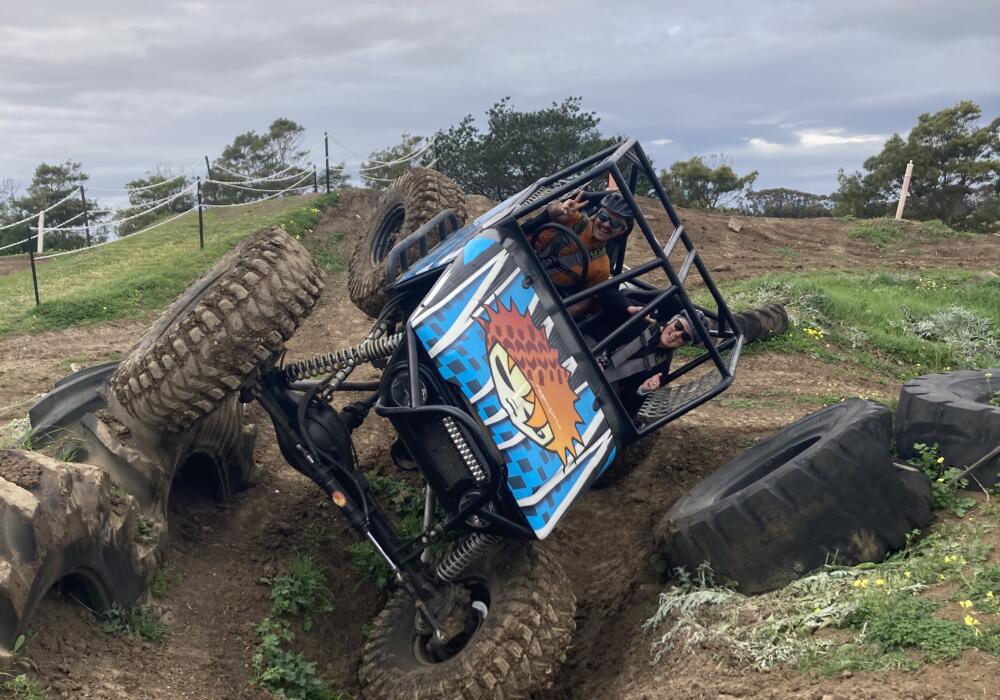
You’re halfway up an obstacle with the buggy leaning at an angle that feels completely wrong. One tyre is climbing while another drops away. The whole vehicle is slowly moving underneath you.
And because nothing is happening quickly, you get to feel every part of it.
You feel the angle.
You watch the bonnet disappear.
You look through the windscreen and see nothing but sky.
You feel the buggy shift its weight another few centimetres.
Then I tell you:
“Keep coming.”
And you have plenty of time to appreciate just how crazy the whole thing feels.
That’s what makes slow-speed driving so different.
You don’t just get an adrenaline hit.
You sit in it.
“It just doesn’t let up”
A few years ago I had a pair of parachute instructors come out for a drive.
These were people who jumped out of aircraft for a living, so I was pretty interested to hear what they thought.
Afterwards, they summed it up perfectly.
When you jump out of a plane, they said, the crazy part is over pretty quickly.
Ragged Edge was different.
“It just doesn’t let up.”
Every time they thought they’d reached the hardest part, the next section got harder and crazier.
That’s exactly what happens.
You start by learning the buggy.
Then the terrain gets steeper.
Then you’re balancing it at angles that don’t feel possible.
Then you’re climbing, dropping, using rear steer and putting the vehicle into positions your road-driving brain insists vehicles really shouldn’t be in.
You finish one obstacle.
You breathe.
Then you look at the next one.
And think:
“You’ve got to be kidding.”
It’s not about being fearless
The other thing that makes it different is that you’re driving.
You’re not strapped into the passenger seat waiting for someone else to get you through it.
You’re the one controlling the buggy.
That means feeling everything the vehicle is doing while still making the small inputs that get you through.
A little more throttle.
Hold the steering there.
Let the front climb.
Wait.
Now turn.
Now rear steer.
Now another few centimetres.
The challenge isn’t being fearless.
It’s discovering that the buggy can do far more than your instincts initially tell you it can.
And doing it slowly means you experience every second of that discovery.
Walking pace can feel very, very fast
That’s why I don’t think adrenaline should be measured in kilometres per hour.
There are plenty of places you can go fast.
Ragged Edge isn’t really about speed.
It’s about putting a vehicle into situations that don’t look possible, then slowly driving your way through them.
Sometimes the buggy might only move a metre.
But that metre can take 30 seconds.
Sometimes longer.
Thirty seconds where your heart rate is up, your hands are tight on the wheel and every part of your body is telling you that gravity is about to become a much bigger part of your day.
Then you reach the top.
You breathe.
You laugh.
You look ahead.
And realise the next obstacle is worse.
Welcome to the Ragged Edge.